
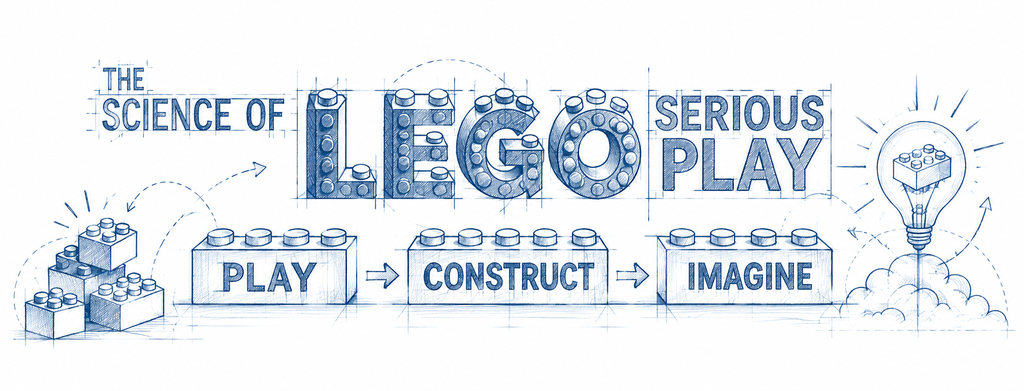
PLAY-CONSTRUCT-IMAGINE
SERIOUS PLAY is the name for the process that LEGO® SERIOUS PLAY® has developed to bring the creativity, the exuberance, and the inspiration of play to the serious concerns of adults in the business world. The three key elements that make up the foundation of LEGO SERIOUS PLAY are: 1) Playing 2) Construction, and 3) Imagination, which leads to finding identity.
SERIOUS PLAY is a concept developed over several years by Executive Discovery, a member of the LEGO Group. It emerged out of the research and experience of a number of academics and practitioners searching for more effective ways to meet the increasingly complex and challenging demands of the business world.
The LEGO Group became involved with SERIOUS PLAY very early in its development, both as a user of the process and as a company whose basic values are in complete alignment with the core ideas presented here. The name LEGO itself is a contraction of the Danish phrase “Leg Godt,” which means “Play Well.” In spearheading the development of LEGO SERIOUS PLAY, LEGO and Executive Discovery show their dedication to supporting the child in each and every one of us to “Play Well.”
The LEGO Group became involved with SERIOUS PLAY very early in its development, both as a user of the process and as a company whose basic values are in complete alignment with the core ideas presented here. The name LEGO itself is a contraction of the Danish phrase “Leg Godt,” which means “Play Well.” In spearheading the development of LEGO SERIOUS PLAY, LEGO and Executive Discovery show their dedication to supporting the child in each and every one of us to “Play Well.”
PLAY: Learning Through Exploration and Storytelling
The LEGO Group became involved with SERIOUS PLAY very early in its development, both as a user of the process and as a company whose basic values are in complete alignment with the core ideas presented here. The name LEGO itself is a contraction of the Danish phrase “Leg Godt,” which means “Play Well.” In spearheading the development of LEGO SERIOUS PLAY, LEGO and Executive Discovery show their dedication to supporting the child in each and every one of us to “Play Well.”
Most people view play as the very opposite of work, as something frivolous, as an activity to fill the leisure time when we are not attending to our more serious concerns. The LEGO Group has always taken play very seriously. We define play as a limited, structured, and voluntary activity that involves the imaginary. That is, it is an activity limited in time and space, structured by rules, conventions, or agreements among the players, uncoerced by authority figures, and drawing on elements of fantasy and creative imagination.
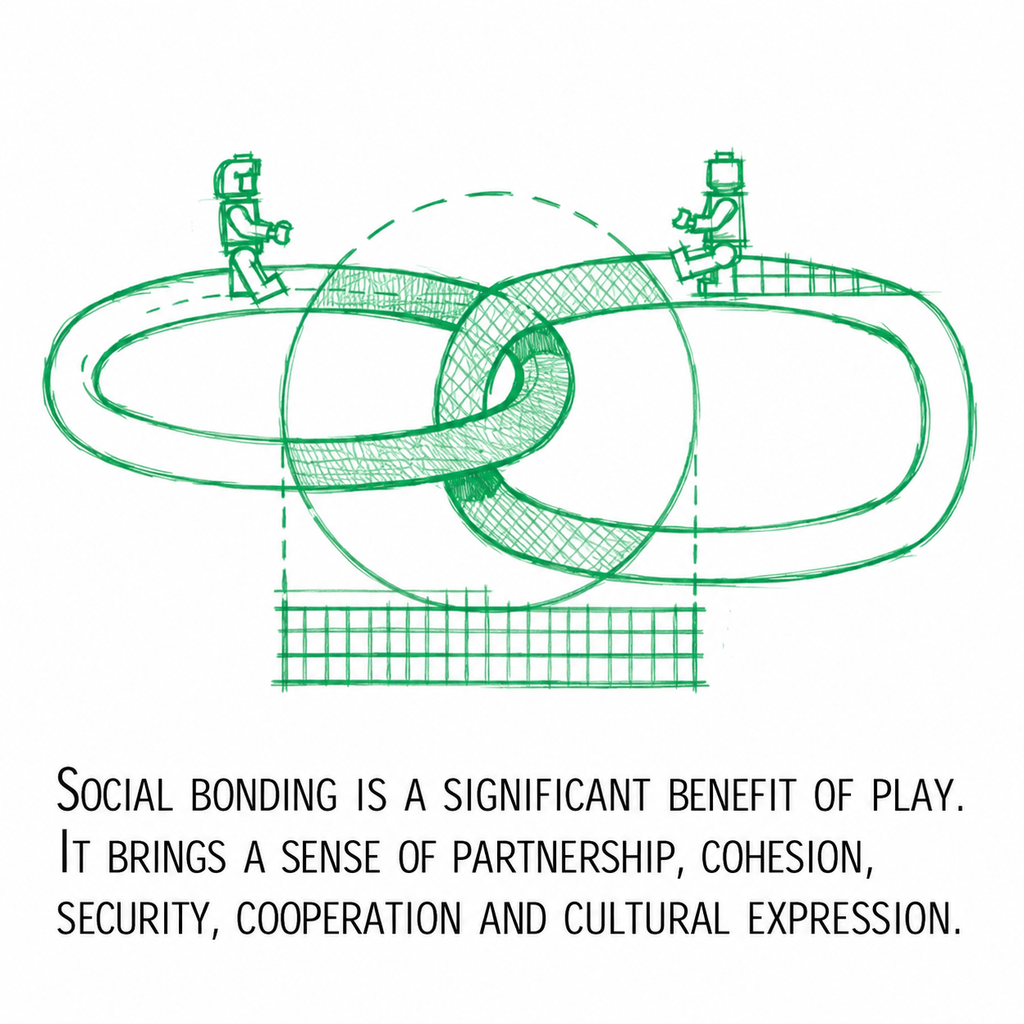
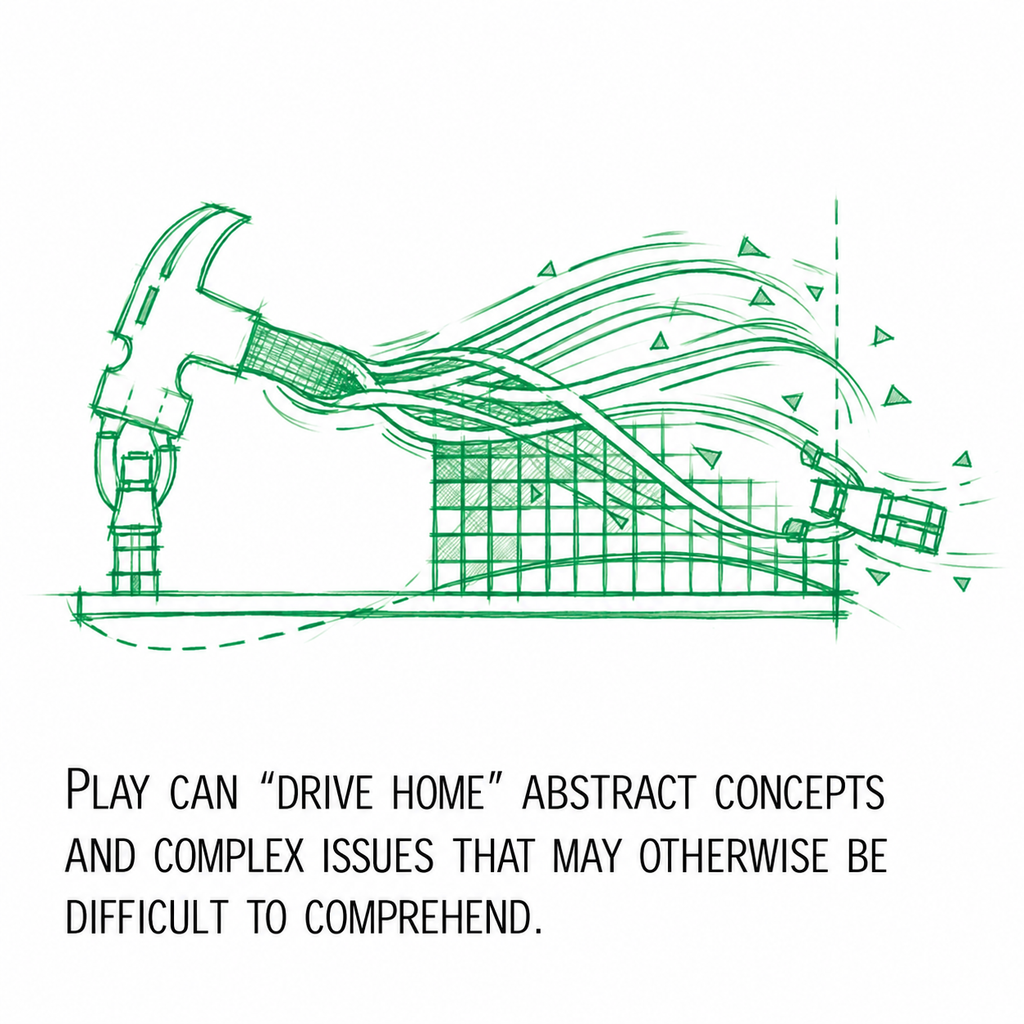
Storytelling and Metaphor
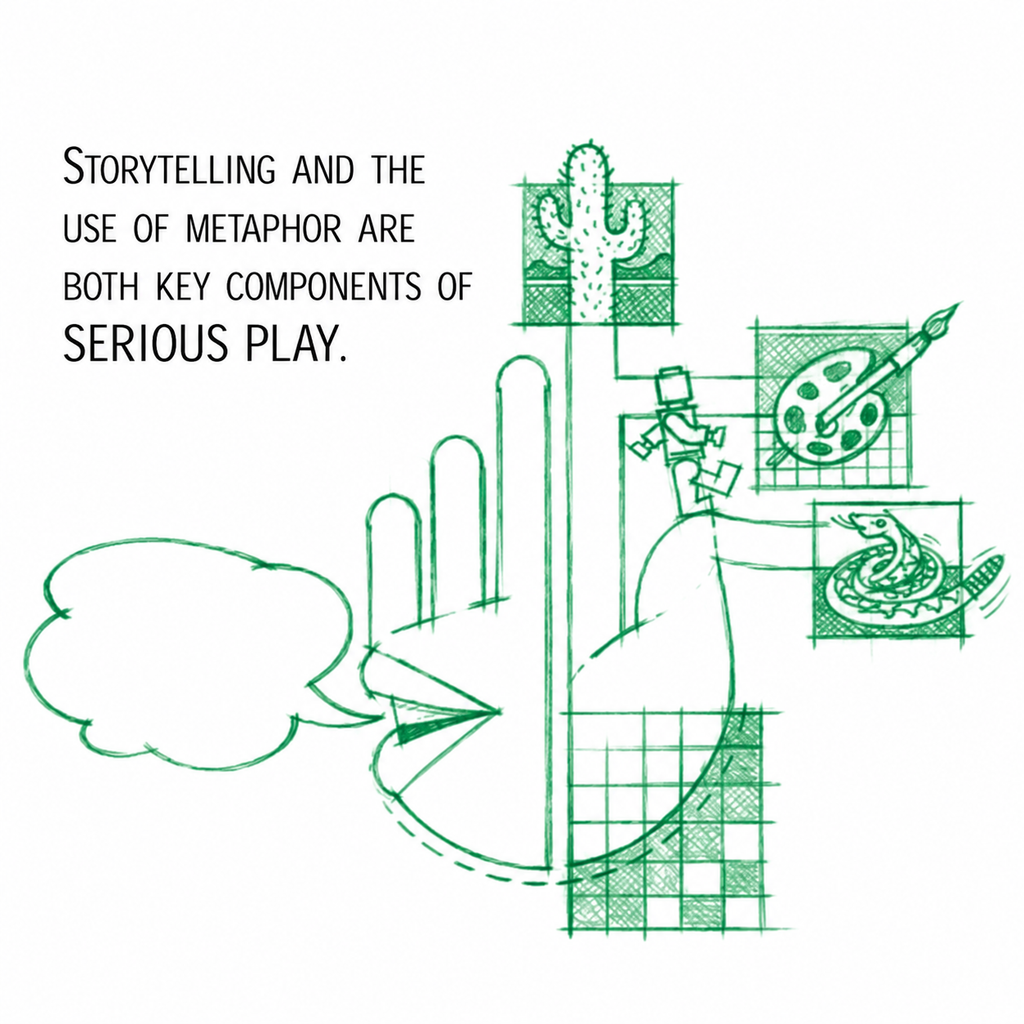
Storytelling and the use of metaphor are both key components of play. When children play, ordinary objects are transformed into mommies and daddies, animals, trucks and cars, and all sorts of characters in the narratives that children create in their play.
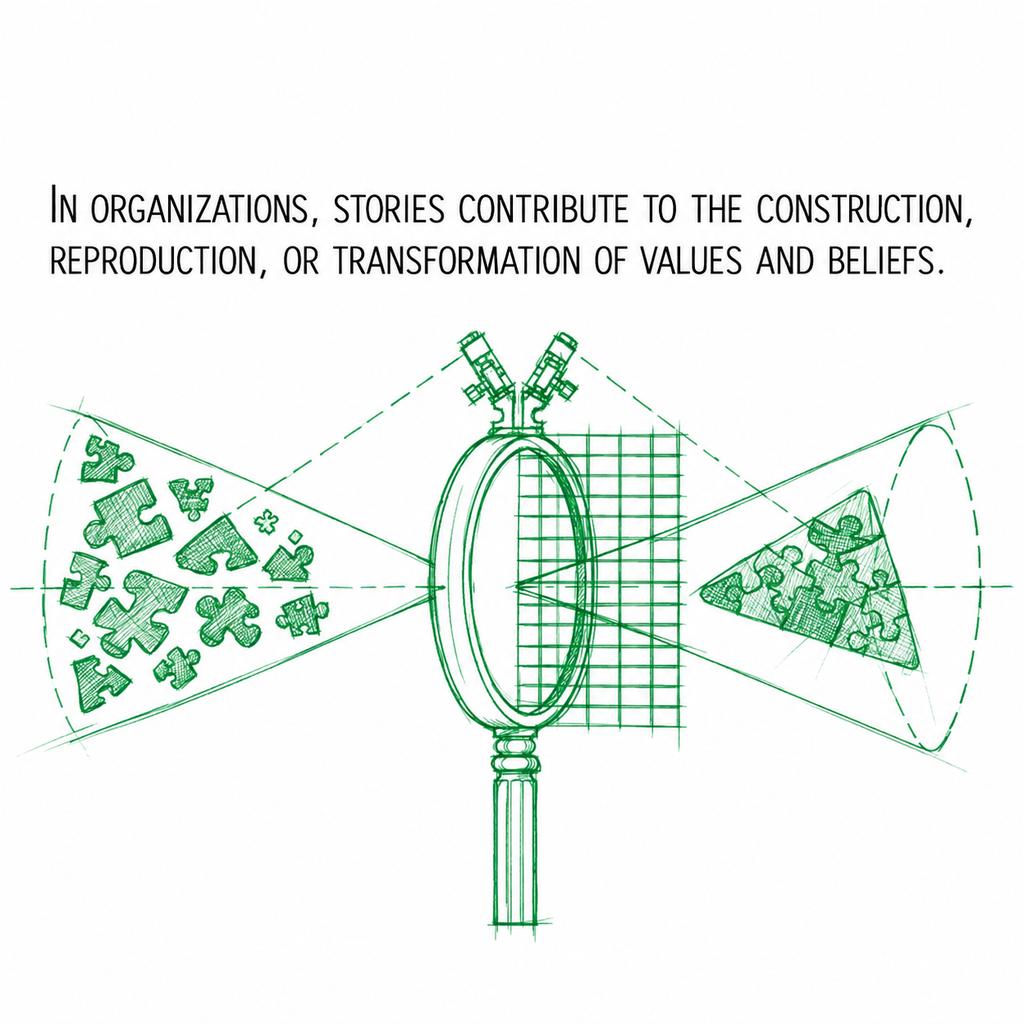
In organizations, stories contribute to the production, reproduction, transformation, and deconstruction of organizational values and beliefs. Organizational members dramatize organizational life through stories transforming mundane events into symbolic artifacts that contribute to the organization’s history. In this respect, members have the power to “challenge” their organizations with a new story.
In organizational contexts, narratives serve a number of purposes: the socialization of new members, the legitimization of bonding and organizational identification, cultural control, and they serve as a lens through which organizational action may be understood and interpreted. The most vivid storytelling makes ample use of the linguistic construct known as metaphor; that is, a form of thinking and language through which we understand or experience one thing in terms of another.
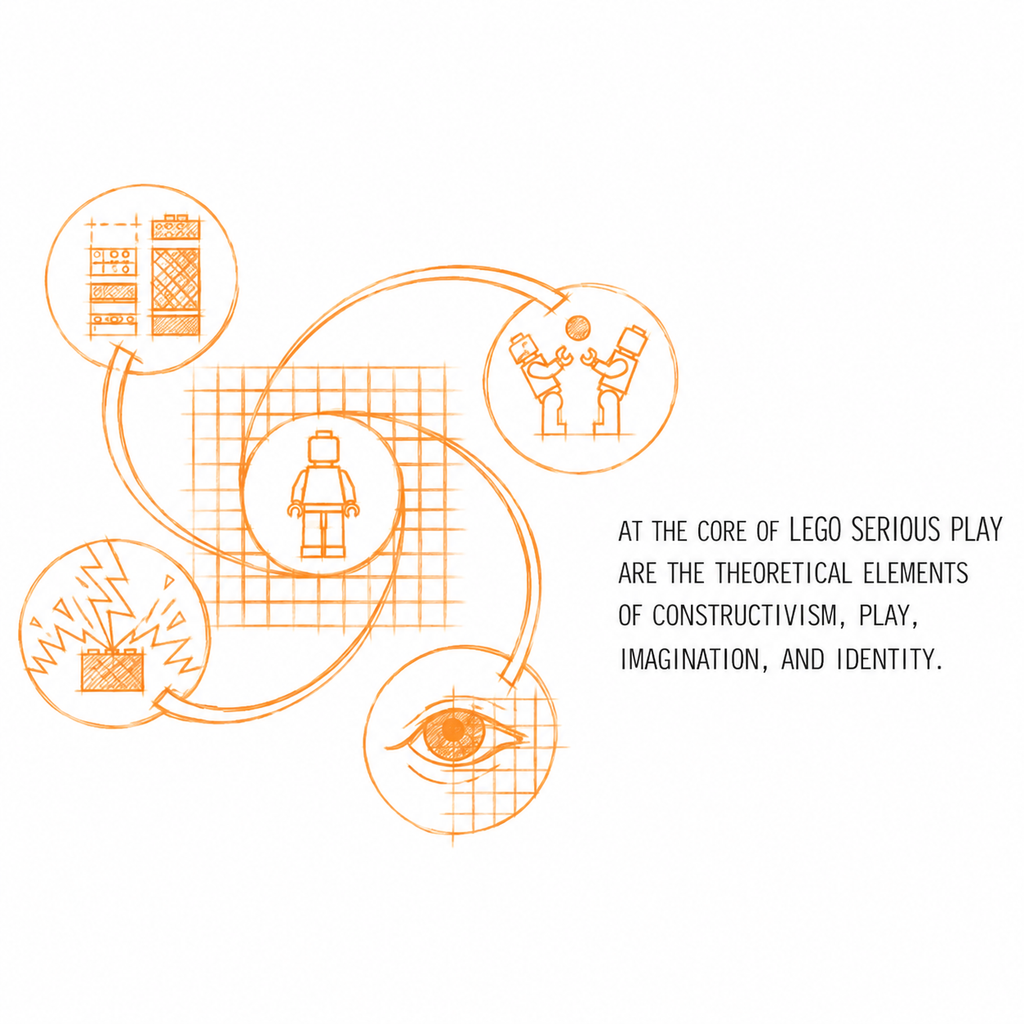
LEGO SERIOUS PLAY draws on many ideas from the fields of psychology and behavioural science.
Constructivism and Constructionism: Building Knowledge by Building Things
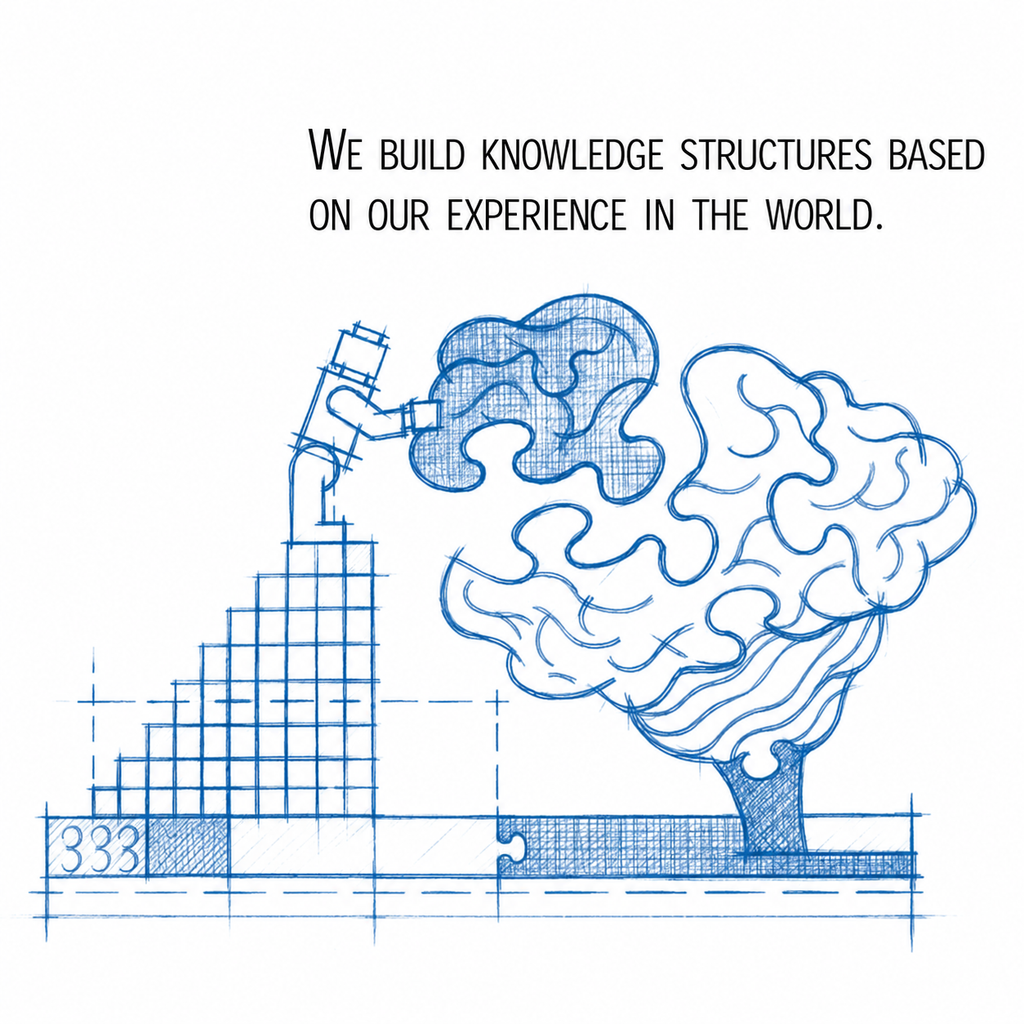
Constructivism – a theory of knowledge developed by Jean Piaget, his colleagues and his institute in Geneva, Switzerland. According to this theory, knowledge is not simply “acquired” by children bit by bit, but constructed into coherent, robust frameworks called “knowledge structures.” Children build these structures based on their experience in the world.
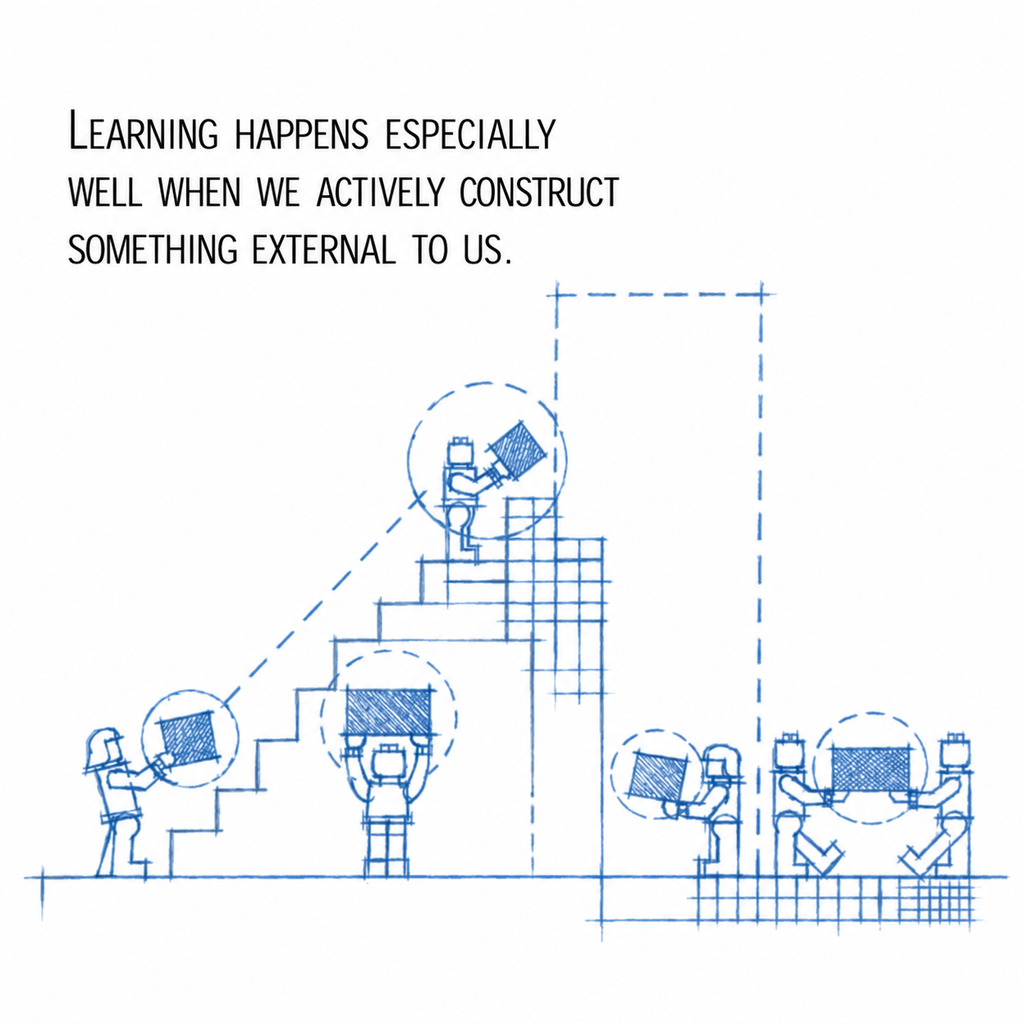
Constructionism – a theory of learning developed by Seymour Papert and his colleagues at MIT in Cambridge, Massachusetts (USA). This theory asserts that constructivist learning happens especially well when people are engaged in constructing a product, something external to themselves such as a sand castle, a machine, a computer program, or a book.
Since constructionism incorporates and builds upon the theory of constructivism, two types of construction are actually going on, each reinforcing the other. When people construct things out in the world, they simultaneously construct theories and knowledge in their minds. This new knowledge then enables them to build even more sophisticated things out in the world, which yields still more knowledge, and so on, in a self-reinforcing cycle.
The Value of Concrete Thinking
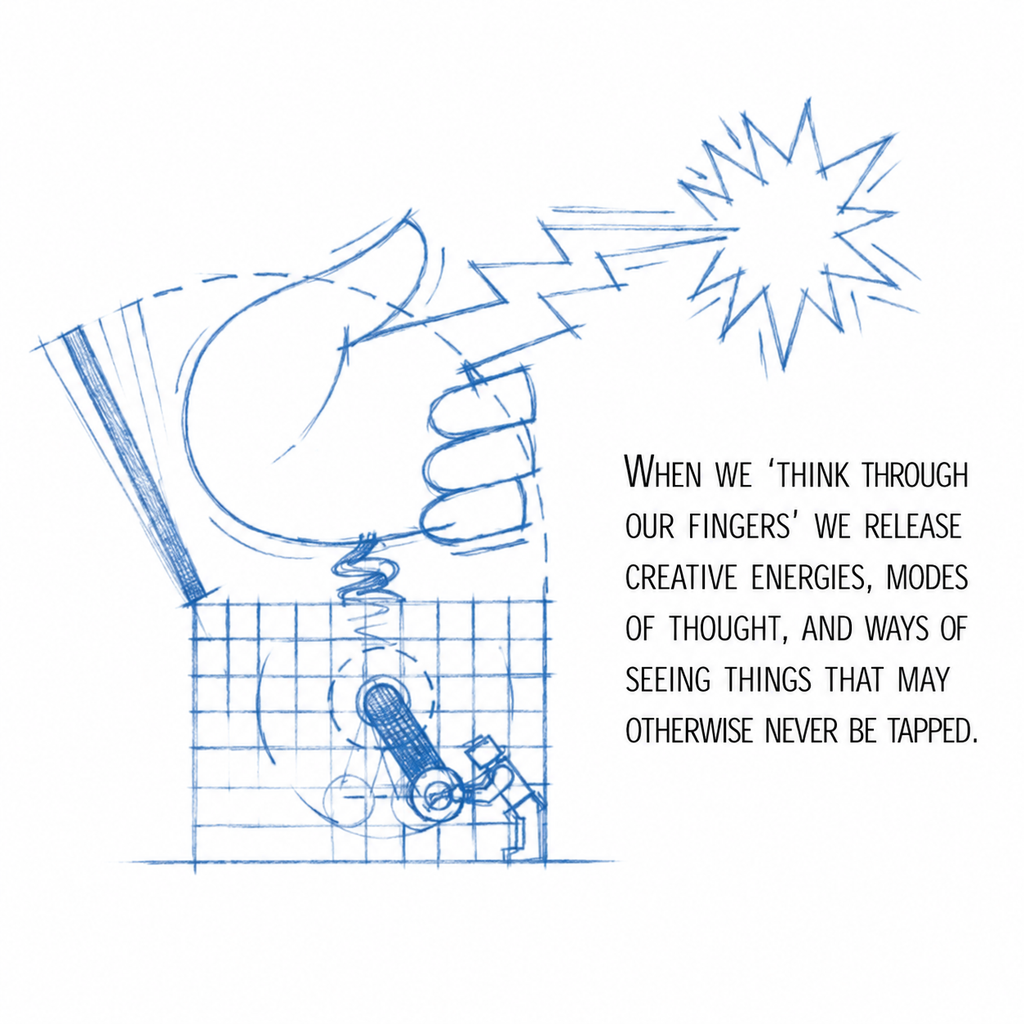
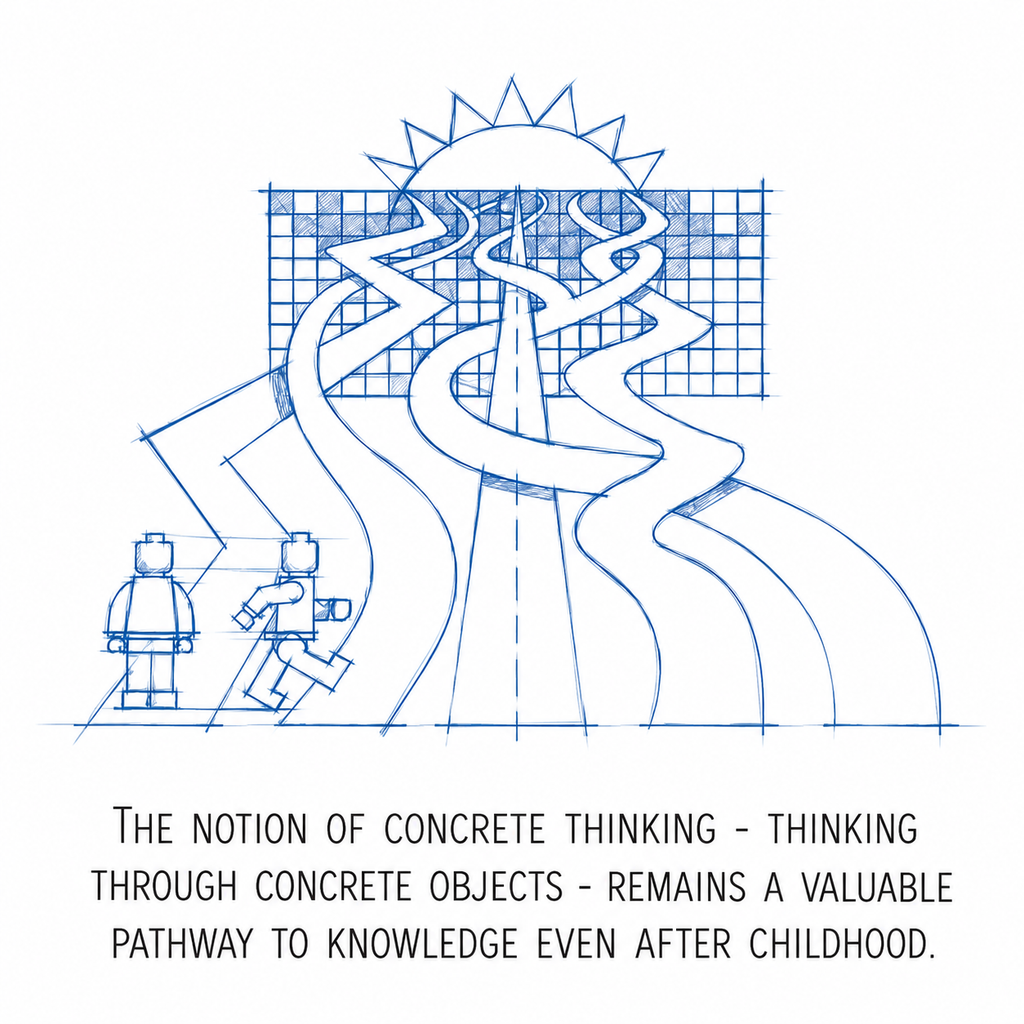
The notion of “concrete thinking” is a style of thinking that has its benefits and uses, just as logical or formal thinking has its benefits and uses. At the core of this concept is that when we “think with objects” or “think through our fingers” we unleash creative energies, modes of thought, and ways of seeing that most adults have forgotten they even possessed. But we were all children once, and we all knew how to play. LEGO SERIOUS PLAY stakes its reputation on the belief that adults can regain their ability to play, can dust off those modes of concrete thinking and put them to use again, and that when they do, great benefits are in store for them.
A business or company is so much more than a building and the people in it. It is a vast network of interconnections and complicated relationships on many different levels. Conveying such abstract relationships on paper through graphs, flowcharts, block diagrams, etc. often fails to capture the dynamic nature of the enterprise. While computer modeling and simulations are a step up from static models, these too are limited. It is often very difficult to comprehend the totality of these complex interrelationships.
LEGO SERIOUS PLAY is a bold attempt to take the power of constructionism and apply it to the complexity of the business world, thereby making the abstract network of interrelationships that make up any business, concrete, appropriable, and comprehensible.
When a “model” of a business is constructed – not of the buildings, but of the business in a systemic sense – people see things they couldn’t see before. They can look at a 3-D metaphorical model of their business and its landscape and visualize strategies that were formerly opaque and closed off to them. They can see their business enterprise in a more holistic sense. They can manipulate it, play with it, and ask all sorts of “what if” questions by physically manipulating their business model. “What if our key supplier goes bankrupt?” “What if we relocated our marketing team to Asia?” “What if our sales suddenly doubled?”
Getting managers and employees to “play” with their business may seem like a radical departure from the serious concerns of the boardroom. But that depends on your notion of play. Seeing play not as a leisure pursuit but as a serious activity that can unleash creative energies so sorely needed in the business world today, leads us even more deeply into the core ideas of LEGO SERIOUS PLAY, and that is where we shall turn next.
IMAGINATION: Tapping Into Our Creativity
When a “model” of a business is constructed – not of the buildings, but of the business in a systemic sense – people see things they couldn’t see before. They can look at a 3-D metaphorical model of their business and its landscape and visualize strategies that were formerly opaque and closed off to them. They can see their business enterprise in a more holistic sense. They can manipulate it, play with it, and ask all sorts of “what if” questions by physically manipulating their business model. “What if our key supplier goes bankrupt?” “What if we relocated our marketing team to Asia?” “What if our sales suddenly doubled?” According to LEGO SERIOUS PLAY, it is the interplay between three kinds of imagination – description imagination, creative imagination and challenging imagination, that make up what we call strategic imagination – the source of original strategies in companies.
The role of DESCRIPTIVE IMAGINATION is to evoke images that describe a complex and confusing world “out there.” This is the imagination that identifies patterns and regularities in the mass of data generated by rigorous analysis and informed by judgment based on years of experience. The literature on strategic management prescribes a wealth of techniques to stimulate our descriptive imaginations. Value chains, 2-by-2 matrices, flowcharts, as well as more artistic pictures of the business environment are all examples of such techniques, as is the delineation of future business scenarios. Each of these methods focus on revealing patterns and seeing things in a new way.
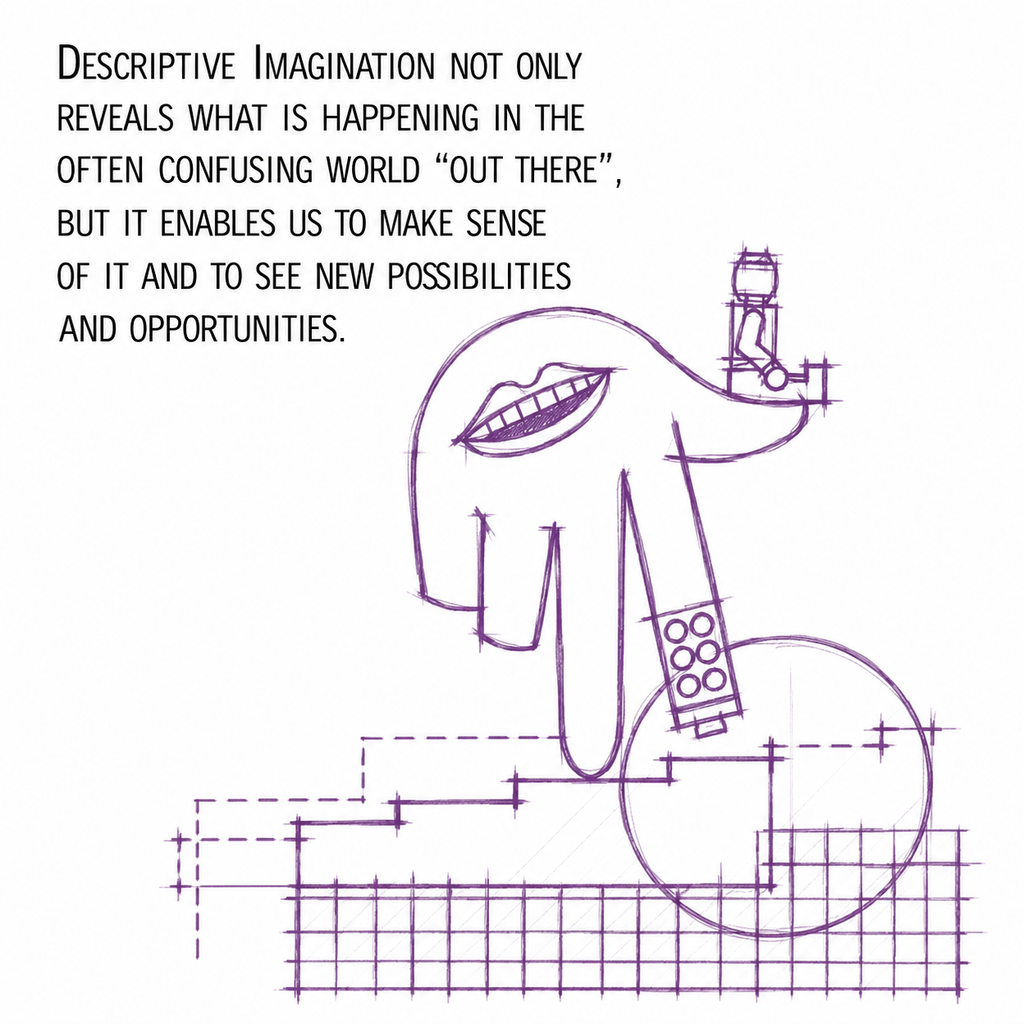
Without Descriptive Imagination, strategy makers have only blind variation and luck – or lack of it – to rely on. Descriptive Imagination, then, enables us to see what’s going on in front of us, to make sense of it, but also to see new possibilities and opportunities within an often complicated, dynamic array of interactions.
CREATIVE IMAGINATION occupies a central role in the literature on strategy making. It is the essential feature of visioning, “skunk works,” brainstorming, and thinking “out of the box.” Whereas Descriptive Imagination enables us to see what is there in a new way, Creative imagination allows us to see what isn’t there; that is, to create something really new, something totally different.
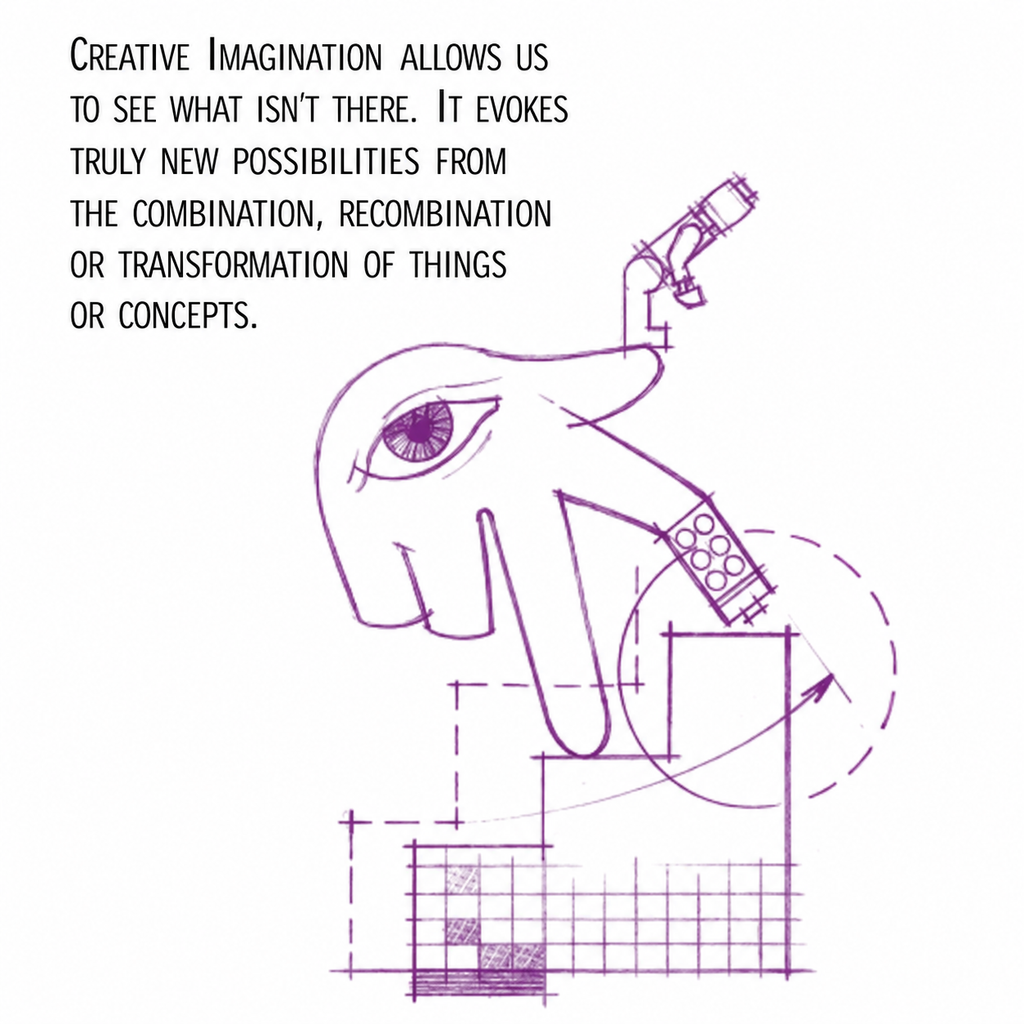
Creative Imagination is associated with innovative strategies where companies sought to make their competitors irrelevant rather than just beating them at their own game. Creative Imagination was at work when Michael Dell developed the strategy of make-to-order mass production for PCs and when companies like Victorinox, Harley Davidson, and Nike extend their brands to new markets and new products. The motivation for Creative Imagination lies in the dissatisfaction people feel with current choices. Many management concepts and techniques, like TQM, stimulate managers to innovate “new ways of being” that are better than the current state.
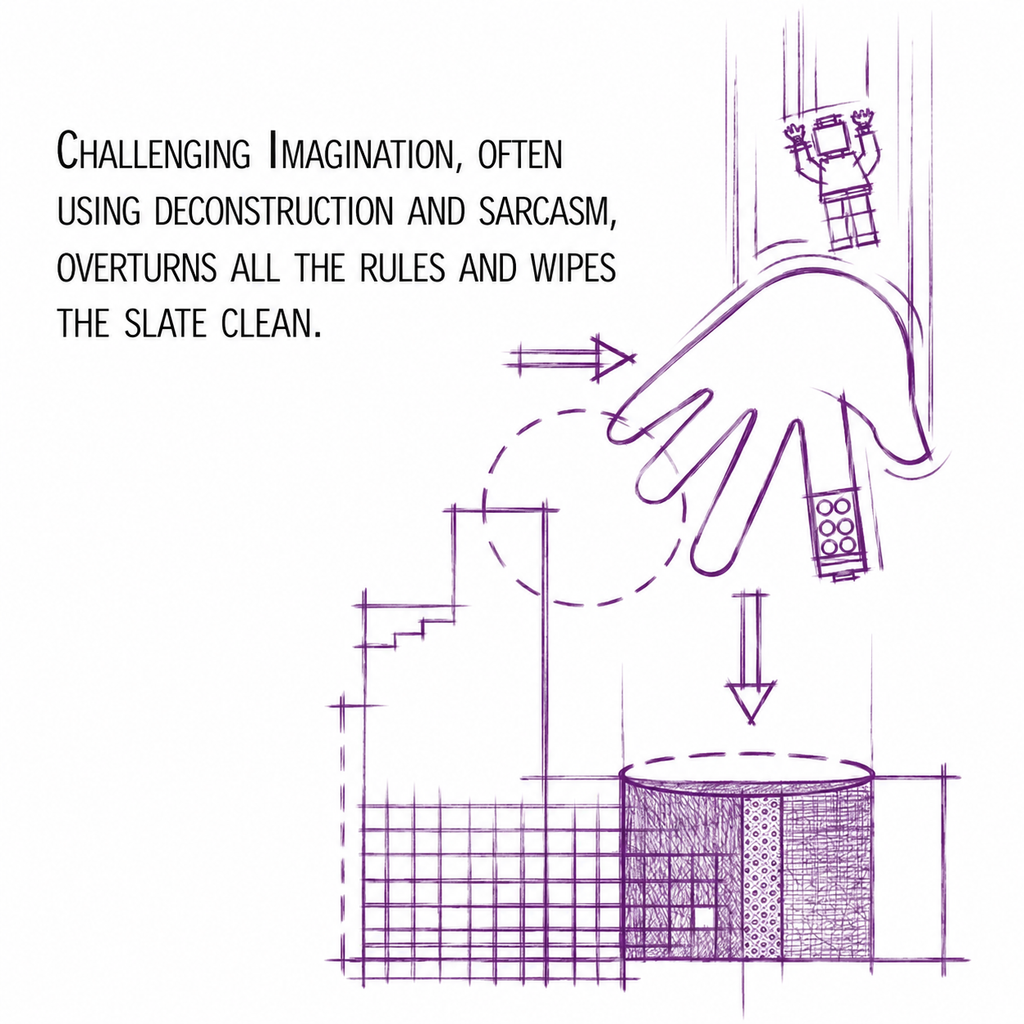
CHALLENGING IMAGINATION is completely different from the other two kinds. It is with challenging imagination that we negate, contradict, and even destroy the sense of progress that comes from descriptions and creativity. Challenging Imagination overturns all the rules and wipes the slate clean. It goes beyond creative imagination in that it does not merely add on a new element to what’s already there. Challenging Imagination starts from scratch and assumes nothing.
The methods of Challenging Imagination include deconstruction and sarcasm. The Challenging Imagination was necessary at Nokia when the company left behind its tradition of wood products and rubber boots to become a telecom innovator. The Challenging Imagination was also essential in the reinvention of such companies as IBM, Phillips, and Alcatel. Deconstruction in this sense is often paired with sarcasm. Sarcasm is the recognition that there is no sacred thing at the ‘truth’.
CHALLENGING IMAGINATION is completely different from the other two kinds. It is with challenging imagination that we negate, contradict, and even destroy the sense of progress that comes from descriptions and creativity. Challenging Imagination overturns all the rules and wipes the slate clean. It goes beyond creative imagination in that it does not merely add on a new element to what’s already there. Challenging Imagination starts from scratch and assumes nothing.
What we are calling STRATEGIC IMAGINATION is a process that emerges from the complex interplay among these three kinds of imagination. While this interplay of imaginations is not directly observable, what we can observe are the manifested social dynamics among the strategy makers. These social dynamics fall into three categories:
1. the construction of knowledge gathered from knowledge and experience;
2. the sharing of meaning emerging from that knowledge;
3. the transformation of identity assimilating the new knowledge.
CHANGE YOUR ORGANISATION THE BETTER WAY
Ready to build your future?
Bring us the challenge. Let’s design your LEGO® SERIOUS PLAY® session today!